Sunday, June 20, 2010

A Day in the Life


Me with my 6th graders in our classroom.


The year is winding up. Thought I would share a typical day with you. I'm about to head out on our final YAV retreat. Upon return, only one month left!

• 6 am- Wake up- it’s still dark. If motivated, go for a short sunrise walk to take in the colors framed by mountains. It’s usually pretty chilly, but refreshing.

• Coffee. Breakfast- usually complimented by some delicious fresh fruit (pineapple, papaya, mango, oranges, tangerines, sweet bananas...).

• 7:30 am- morning assembly. The whole school (about 150 of us) classes 1-8 and the nursery school gathers for a short worship service. Singing and dancing to wake us up, a word from the Bible made by the director, and announcements for the day. Exceptions are on Thursdays and Fridays. Thursdays are our music competitions where all the classes compete with their best songs and dances. Fridays we have the Scouts lead us in a processional for the flag raising.

• 8:40-11:10 am- morning classes. On any given day, I teach 6-8 thirty-five minute lessons. I teach English to 5th and 6th graders (though all subjects are also taught in English), C.R.E. (Christian Religious Education) to 4th and 7th graders, and “Creative Arts” (music, drama, visual arts and crafts) to 4th-7th graders. Occaisonally P.E. or whatever else they want to throw my direction.

• 11:10-11:40 am- Teat Time. Religiously observed by both students and teachers. We usually hang out in the teacher’s lounge and drink our tea away from the pupils and argue about some “topic of the day.”

• 1:00-2:00 pm- lunch time. Kids are not picky eaters. They are either served Pilau (a spiced rice, meat and onion combo), Githeri (corn and beans mixed with whatever vegetable is on hand), or Rice and Beans. Sometimes, the national food, Ugali- corn flour and water cooked together to make a sort of solid that definitely sticks with you- eaten with Sukuma Wiki- cooked greens.

• 2:00-4:20 pm- afternoon classes.

• 4:20-5:00 pm- extracurricular activities. Monday and Fridays: Games in the field (usually football/soccer or “net”ball- similar to basketball). Tuesdays: Debate- classes debate a different topic each week for good practice in English. Wednesdays: Christian Union fellowship- a worship service for the whole school. Thursdays: clubs (I sometimes help out with music and drama club or Journalism club). Our biggest and most popular club is the Scouts who usually practice marching at this time.

• 5:00-6:00 pm- day scholars go home to their parents, the boarding pupils grab their buckets to fetch water and take their baths. I usually run to the market to fetch whatever I’m cooking myself for dinner (since it's been cold, I have become the SOUP master- delicious with all the available fresh veggies and spices).

• 6:00-7:00 pm- boarders eat dinner together after a short devotion. I sit on my porch and watch the sunset.

• 7:00-9:30 pm- boarding students attend night preps where they watch the evening news together and then work on their homework. They get extra assistance from their teachers. I sometimes attend these sessions. Otherwise, I’m at home grading papers, planning lessons, cooking…

• 10:00 pm- we call it a day.


The waterfalls in Meru. About a 10 min walk away from my house.

Monday, June 14, 2010

Women in the Kitchen

I remember during my YAV interview being asked a specific question, “How will you handle the difference of women’s roles in Kenya?" My interviewer, and now my program coordinator, went on to tell a story about different cultural perspectives on this issue from her time touring Africa with Archbishop Desmond Tutu. Since she was a woman, she was many times delegated to “kitchen duty” when they went to new venues. Now, Rev. Phyllis Byrd-Ochilo is definitely someone you do want in your kitchen (YAVs live for the times when she cooks for us), but she is definitely not one to take a back-seat to any man. She explained how at first, she saw this as an insult, like they thought that’s all women were capable of doing. It took her awhile to see that serving in the kitchen was actually an honor that they granted her, not something that they were limiting her to. By letting her into the kitchen, she was given access to the communi

My kitchen initiation didn’t come as fast as Phyllis’s. In fact, I had the opposite problem when I first moved here. No one would let me in the kitchen. It was always, sit here, drink this tea, while I prepare the supper. Always a guest. While this hospitality gesture was more than nice, it became frustrating that people were always serving me, when I had come under the guise of a “service” program. This is obvious lesson #1: one always seems to receive much more than they are given. It’s hard to take in, though, no matter what. Maybe the third month in, I was allowed to wash some dishes. That felt nice.

But this month, my ninth month here, I was asked and given full responsibility over: preparing the tea. A big deal, and actually a big honor, considering how essential the morning (or any time of day) cup of tea is. I had a minor panic attack at the responsibility. I usually take the easy way out with the tea bags mixed with milk and sugar, but they wanted the real deal: milk, tea leaves, using the sieve. I did not fail, though I made a mess. As all of us women took tea in the kitchen (instead of the living room/dining room/ “visitor’s room”), I was able to see clearly how far we had come.

You see, the kitchen is sort of where the magic happens. This time, we had four of us women preparing for a big family meal. The director of the school’s family has sort of a round-robin fundraiser where the host of the meal gets the family’s funds donated to them that month to help them in their educational/vocational/professional pursuits. We cooked and we cooked. Starting Friday night and ending Saturday afternoon… And we talked. And we laughed. We took several tea breaks. They chuckled at the way I sliced the cabbage. I was amazed that they never seemed to tear up while cutting onions. I learned their secret cooking tips, and was privy to family information I had never been exposed to previously. They praised me by saying I was now a “real African lady.” And I realized that I could not have earned this title any sooner. If I had some of those responsibilities in the beginning, I would have just been doing “work”- giving to them, performing service. I needed to first learn from them. “Slowly by slowly” (kiswahili, “pole pole”), by letting them know I was open to assisting where possible, they let me in. Eventually, it wasn’t me helping them or them serving me, but us be-ing in the kitchen together, enjoying each other’s company. We finally hit that sweet space of mutually benefiting from each other.

I think this is the main reason why I have been enjoying Kenya so much more in my final lap. No longer am I a foreigner, the mzungu, or that American. I’m Teacher (mwalimu) Deanna, or even Kendi in the Kimeru tongue and Wanjiku in the Kikuyu language. I feel connected, part of their culture. Looking back to YAV orientation, I remember talking about the different perspective changes we would go through. First, you would start out in “homeland”- which is when you compare everything to home, are still thinking in that direction. Then, there’s “wonderland,” where everything is new, exciting and amazing. Some naivete in this stage. What follows, I would insert, is “wander-land,” where you start to doubt your reasons for being there, when you question both cultures equally and are kind of lost. Then, finally you return home, but not the same one- to “new-found land.” I think I have arrived here at long last. It’s home, for all its ups and downs, quirks and good qualities.

As of late, I am really busy teaching lots of classes, working on special projects, heading up meetings, and cooking for family guests on a regular basis. If I was still in wonderland, I would have been doing all this for people, to help them. Now in new-foundland, it is work done to contribute to the community, to do my part as others are doing theirs. They ask here many times in public speaking, “are we together?” as a sort of “are you listening?” But now I can see what that question is really getting at- it’s extremely important to be- together.

Monday, May 31, 2010

Endangered Beauty


“I Scarce Can Take It In,” the line from that beautiful old hymn, “How Great Thou Art,” keeps running through my head. As soon as one leaves the bustling streets of Nairobi, there is almost an inescapable connection to nature in this country. There’s the beautiful slopes of Mt. Kenya, the rolling foothills that have a range of their own (which is where I live), pastoral deserts in the northeast, the 2nd largest freshwater lake in the world in the west, a breathtaking coastline in the east, and the vegetation is usually lush and green wherever you go: tea plantations, rice fields, banana trees, flowers everywhere. One is surrounded.

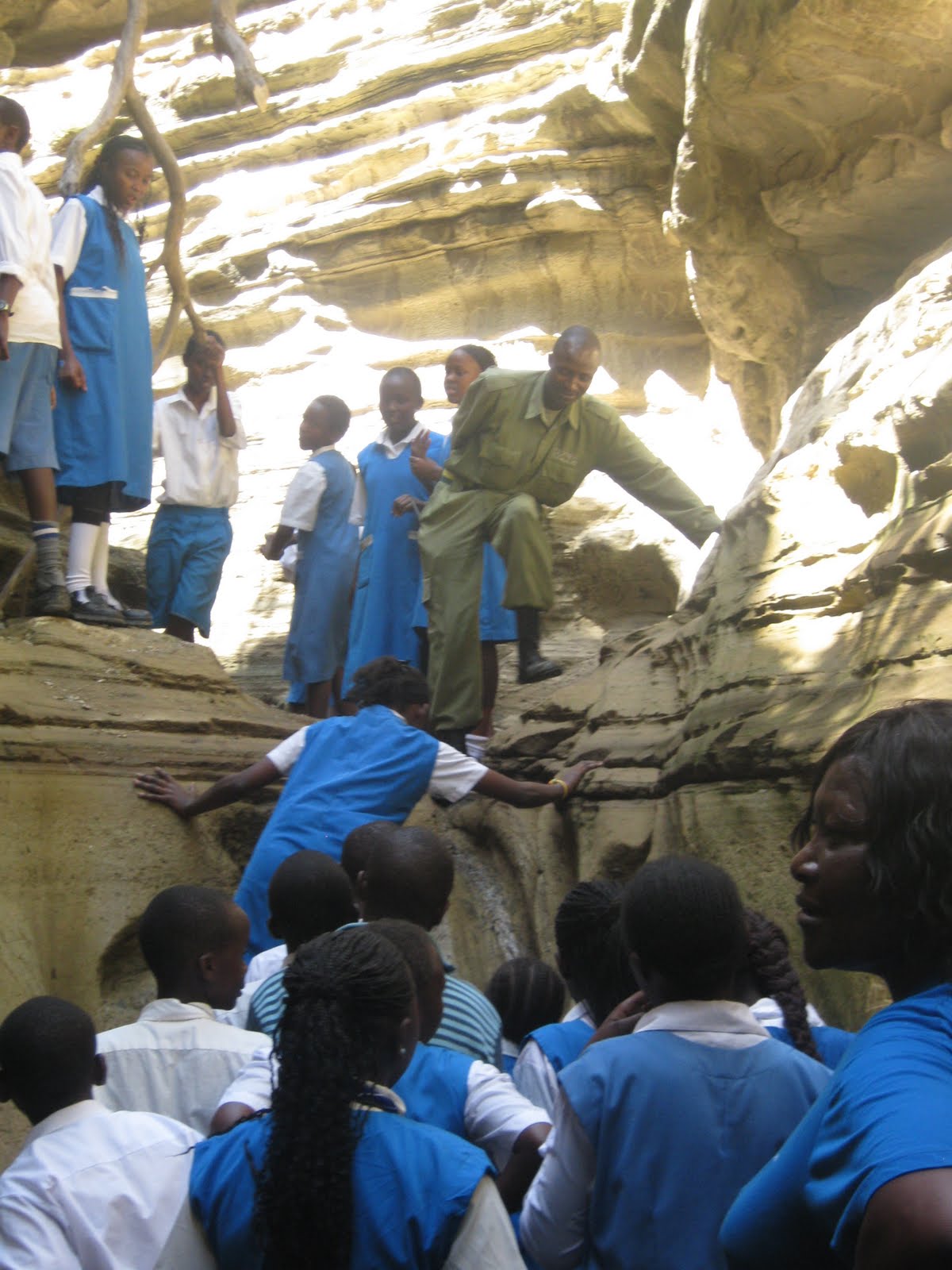
I was especially overcome by it when I went on a field trip with my students to Hell’s Gate and Mt Kenya National Parks. Hell’s Gate, so named for its geothermal hot springs and volcanic rock formations, provided us with a terrific hike. Through rocky streams, narrow crevices, and slippery foot holdings, we made our way to the springs (where you can boil an egg in the water) and the obsidian caves. We couldn’t imagine this being anyone’s hell when we made our final ascent and took in the gorgeous view.

At the foot of Mt. Kenya was an educational center called the William Holden Wildlife Reserve. I was proud that this effort is in partnership with a center in the states founded by the above named man who was a documentary film-maker who couldn’t take in the beauty of the wildlife without also doing something to preserve it. It serves as a wildlife refuge for rare species, among these: the white rhino, the water bongo (a type of gazelle with a unique coat that poacher’s like), and the albino zebras. We spotted all of these on our game drive. Possibly more impressive was the center itself. It stood as an example of sustainability- as in, nothing used there went to waste. They had solar panels for electricity, bio-fuel for gas, an organic garden for food, composting everywhere… In fact our human waste didn’t even go to waste, as it was converted to make fertilizer for the flower garden! The kids also learned how to set up similar projects in their own schools. I’m excited that we’re putting what we learned into practice this week by starting a charcoal making project using all organic materials.


All the beauty, but I can’t help but feel a tension in Kenya currently: between development and tradition, consumerism and conservation. As Kenya is “coming up” as they say, there is question over whether its culture and environment will be preserved, or whether the propensity towards materialism will reign. The education, then, at the center, was for the children to take stock and appreciate what they have so as to do their part to protect it. Unfortunately, we don’t usually appreciate what we have until its gone. It’ll be up to these kids to have a voice.

Our guide throughout the center talked about interconnection, a new English word for most of the students: that our actions in one place inevitably affect another. I wish our country would talk more about that concept, and admit our sins of making countries suffer around the world due to our consumption. And I hope and pray that the generally sustainable ways of life here (like growing your own food in organic gardens, walking most places) will remain and not be tempted towards our example. Nature is a powerful force that has the ability to truly unify us. We can all experience it. Hear God talking…if we will only listen…

I’m definitely feeling a clock winding down to the end of my time here. So much is special and different, that I’m doing my best to stay rooted. Taking walks during sunrise and sunset has definitely helped. Simply “Be-ing” as this YAV program continually reinforces is a tremendous gift when it’s in such awe-inspiring beauty.

Saturday, May 8, 2010

A Communal Kenyan Wedding


Myself and new bf. Wish he had brought a ring for me.

Kageni getting carried into her vehicle by female fam members.

The bride having a pre-wedding cup of tea.

I had such a wonderful time this past weekend in my first Kenyan wedding experience. Mostly, I felt honored to be in the wedding as a bride’s maid and got to really soak up the experience from beginning to end. I was reminded over and over again that it’s not about the parents, the big cake, the dresses, the suits, the presents, or even the married couple to-be, but it was about…the community. Since we don’t really have this sense when it comes to weddings (or many other things), I was very curious how they were going to pull it off. But I am now a believer in this alternative approach to the big event…

The process, for many of us involved, started about four months prior to the wedding. This time when I was whisked away without knowing where I was going, I was taken to a local pub where “the elders” had gathered. The tradition stems from “the old times” when the tribal elders would gather around the fire and either approve or disprove of a marriage proposal (as in, the wannabe husband would propose to the tribal elders eons before proposing to the woman he wanted to marry- in fact after the father agreed as well, she didn’t have much say in it at all, but I’ll leave that for now…). Instead of cain licquor, Tusker beers were passed around in plenty, and the overall tone was one of mutual.merriment. At some point, Njugi and Kageni got around to the “official” announcement of their engagement and desire to start planning the wedding. Cheers were passed around, and then things became a bit serious when the elders started to offer their advice to the young couple. My Kiswahili is still shamefully minimal, but even if it was up to par, I would have no hope of following their mother tongue of Kikuyu. My friend that translated parts told me generally that they had wished them well, that marriage was blessed but not an easy road, but that if they needed any support, the community would offer it to them in any way they could…

From there, it was down to business. Kageni and Njugi gathered up about 20 of their peers to form their “wedding committee.” Every Sunday afternoon for those few months we became their wedding planners and financiers. The tasks of nailing down the photographer, decorater, caterer, etc was all delegated, and everyone had pledged a certain amount to cover the cost. A daunting task became light amongst all of us. After a few meetings, all that was left was to brace ourselves for the big day. Here, they have very open invitation weddings. As in, you are allowed to invite friends of friends even if they don’t know the couple. The event is also announced to the whole church. There is no RSVP involved, so one never knows how many people will show up. They prepare for the whole village.

The week before the big day, about every big reservation was changed at the last minute due to factors beyond anyone’s control. Miraculously, it all got sorted out in time. The morning of the wedding was something I thoroughly enjoyed- about 60 women crammed into Kageni’s mother’s home all dressing and prepping. It was delightfully chaotic with one bathroom and one mirror. Having spent a good five hours on her hair the previous night, Kageni was mostly set. While the groom’s family was negotiating the final dowry details with the bride’s father, we kept the bride’s nerves at bay by dancing, singing and taking pictures. Our singing was soon echoed by all of the women outside, signaling that the negotiations were through. We all lined up, escorting our bride out of Kageni’s house. Our heels kept sinking into the wet ground from the rains the night before and I was horrified how Kageni was going to get into her vehicle with that long white dress… My fears were quelled when I looked behind and realized she was being carried by about 20 of the singing and dancing women.

After a slow ride around town in the flowered vehicles with plenty of honking and whistling, we pulled into the church about noon, two hours after the ceremony was supposed to begin. Of course, no part of the ceremony went as planned. It was hilarious how random people from the congregation kept passing the pastors notes to indicate that they wanted to make a speech or sing a song. Somehow, the pastors were able to keep up. The tear-jerking things that are the same everywhere held emotional weight here as well. The groom fumbled his vows in an endearing way. The bride had at least one big tear, and I’m sure I had a few of my own. After the two hour ceremony, we continued to the reception. We sang and danced to the food line, sang and danced to receive the gifts, to pass out the cake… I didn’t even notice time passing and before I knew it, all the guests were clearing out around 5 pm. We had a bit of time to relax, change clothes, and all the young people sorted themselves out for the big after party, which more or less resembles the reception that you find in the music (even the appropriately cheesy kind), drinks, the fun…

It was a great day all around, and I really did feel like it brought everyone, not just the bride and groom, together.

Sunday, April 25, 2010

May God Agree With Us: A Samburu Prayer


Morning walk, Meru.

Mountain sunrise.

Yes, my God, you will save us:

Yes, my God, you will guide us,

and your thoughts will be with us night and day.

Grant us to remain a long time,

like the great wing of rain, like the long rains.

Give us the fragrance of a purifying branch.

Be the support of our burdens,

and may they always be untied,

the shells of fertility and mothers and children.

God be our safeguard, also where the shepherds are.

God, sky, with stars at your sides

and the moon in the middle of your stomach,

Morning of my God that is rising,

Come and hit us with your waters,

And God said, “all right.”

-Samburu, Kenya, from an African Prayer Book by Desmond Tutu

Monday, April 12, 2010

Pictures...

...can be found here. :)

Lost and Found

When people are gone for a long period of time here, Kenyan friends and family generally greet you with, “Where have you been? You’ve been lost for long…” I haven’t looked it up, but I’m thinking maybe it’s a Kiswahili translation that comes out a little differently in English. I knew right where I was the whole time. I could point it out to you on a map, but this isn’t exactly what they’re talking about here. I wasn’t lost, myself, I was lost to them…the community notices the absence, and the question posed is one of concern and care.

It has made me question the literalness of their question, though. I think I have been feeling a little “lost” as of late in the sense that they mean. I’ve been lost in my own thoughts, mostly about my future. I’ve been lost from home (home) and family (family) for a long time now. But even as a grade school kid, I realized that the best part of getting lost was finding a new way back… In this case, I’m being found…

I was in Kisumu, the western part of the country, for the National Drama Festivals when a kind stranger provided my first example. I was looking around in the evening our second night, hoping to find a cheap place in town to stay when I bumped into someone who immediately said, “you look lost…” I laughed inwardly, and said that I wasn’t lost, I was just looking for a place to stay, and did she know any? She mentioned her hotel and the price, which was too much for me, so I thanked her and thought I was moving on when she promptly told me I wouldn’t find a place at that hour and to please follow her… She whisked me away in her vehicle, found an empty room where she was staying, and decided to sponsor me for the night. I later learned that she worked for the ministry of education and also that she decided to sponsor me for the rest of the week- meals included, no charge. I didn’t really know how to take all the kindness in. My first reaction was to question it, “are you sure this is ok?” “I can really find a cheaper place to stay…” “Is it too much trouble…?” etc. She was a little taken aback by my questions and used the opportunity to tell me, “You see, though Africa is changing a lot, we still operate with a village mentality… when someone is lost and not from here, we have to take them into our village, to provide for them…It is our way.” I reluctantly accepted this new-found way.

Another example was when I “lost” my phone. I’d like to point out that clearly and unmistakably, my phone was stolen, but people over and over kept apologizing for my “phone getting lost…” As soon as it happened though, a search team quickly banded on a red hot hunt. My phone was never recovered, but someone let me borrow theirs until I replaced mine, and I made some friends along the way… The community was again taking on my loss as their own.

Things that I’m now losing as a result of my experience here is my tendency to bare loss on my own, or to not admit when I’m lost and need some guidance. Things are rarely done alone here, and their unwillingness to let me “suffer in silence,” reaffirms what I actually believe: that we are only truly found in community, in relationships with others. It was around Easter time when all of this took place. The holiday that evokes new life, of joy…of accepting a gift of life undeserved and then letting this gift be transformative in your own life. I know these beautiful gifts of hospitality I’ve received all throughout this year are working their transformations in me…

"What is our community, and how might that community be reconciled with our freedom? How far do our obligations reach? How do we transform mere power into justice, mere sentiment into love?... I find myself modestly encouraged, believing that so long as the questions are still being asked, what binds us together might somehow, ultimately, prevail." -Barack Obama, Dreams from My Father